Specialty Coffee Expansion in the Middle East Lifts Demand for Equipment-Protecting Water Filtration
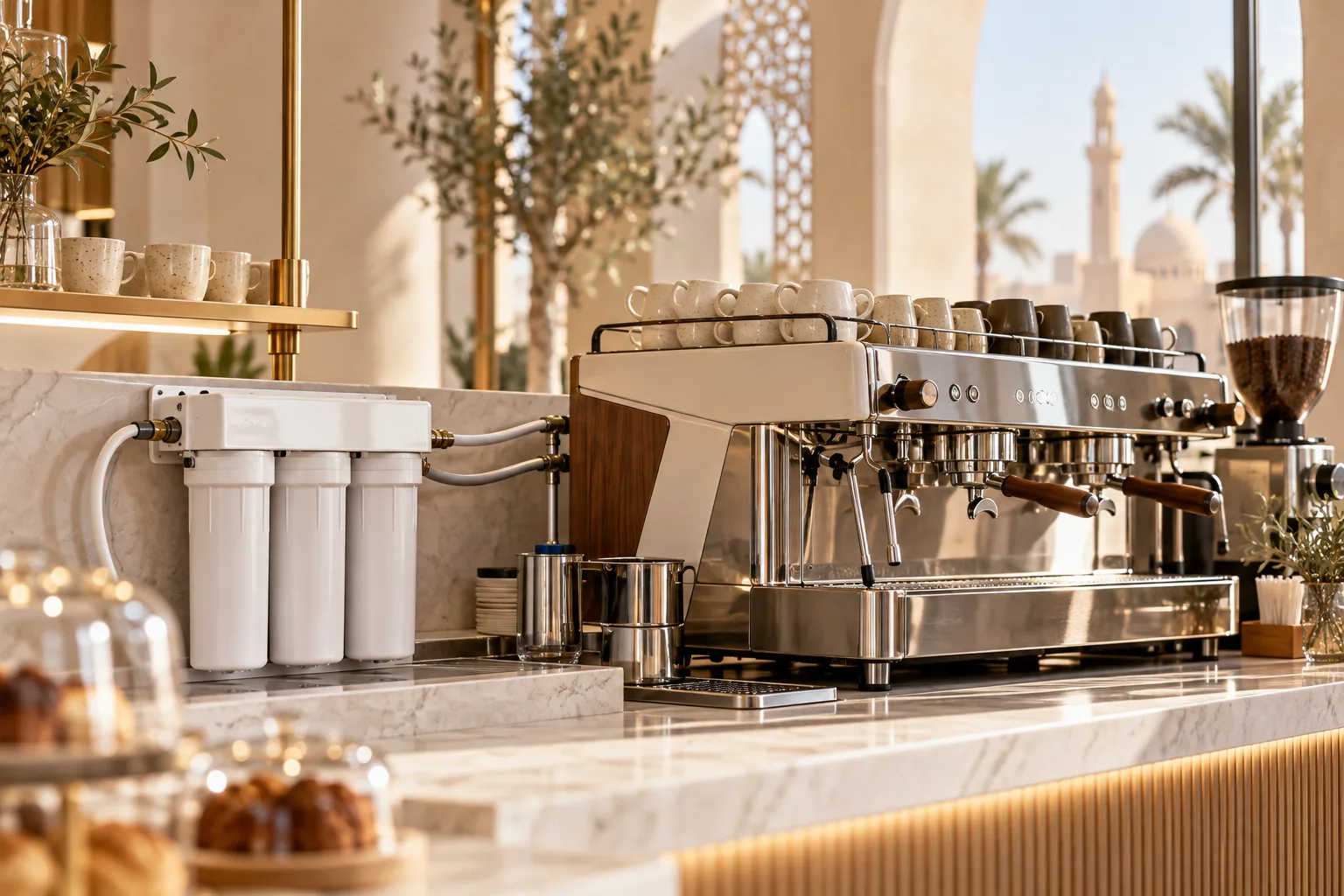
The Middle East’s specialty coffee market is entering a new investment cycle, and it is quietly raising the bar for the water that feeds the region’s growing fleet of commercial espresso machines.
Across the Gulf Cooperation Council (GCC) states and neighbouring markets, café openings, hotel F&B renovations and office coffee service (OCS) rollouts are accelerating. Industry trackers point to double-digit annual growth in branded coffee outlets in Saudi Arabia, the UAE and Qatar, driven by a young consumer base, rising disposable income and aggressive franchising by both international and homegrown chains. For water filtration manufacturers, that growth translates into a specific and predictable demand signal: more espresso machines, more steam equipment and more water-chemistry challenges to solve.
Why equipment protection is the entry point
In most Middle Eastern cities, incoming municipal water is high in total dissolved solids (TDS) and carbonate hardness. Desalinated supply — common in Gulf markets — can be low in minerals but is frequently blended and remineralised to protect distribution networks, which often reintroduces hardness and chloride. The result is water that aggressively scales espresso boilers, group heads and steam wands, and that shortens the life of solenoid valves, flow meters and thermoblocks.
For operators, the cost is concrete: limescale build-up reduces heat-transfer efficiency, causes temperature instability that undermines extraction consistency, and drives higher maintenance call-outs and earlier equipment replacement. A specialty café that positions itself on flavour cannot afford a machine whose temperature drifts between shots.
This is why equipment protection — scale inhibition and particulate removal ahead of the machine — is usually the first filtration decision a new operator makes, well before they begin tuning water for flavour.
From protection to flavour: a maturing conversation
The more sophisticated end of the market is moving beyond protection-only thinking. Operators who a few years ago bought a standard scale-inhibitor cartridge are now asking about target water chemistry, the SCA water standard, and blended reverse-osmosis systems that strip excessive TDS while preserving the minerals that matter for extraction.
That shift mirrors what already happened in Europe and North America, but it is happening faster in the Gulf because of the extreme baseline water. A café in Dubai faces a wider gap between incoming water and ideal brewing water than a café in Milan — which means the filtration solution does more of the work, and operators are more willing to invest in it.
For OEM and private-label partners, this is a meaningful opening. Distributors and equipment suppliers serving the region are looking for cartridge ranges that cover the full spectrum: sediment pre-filtration, activated-carbon chlorine reduction, scale inhibition, remineralisation and blended RO — all in interchangeable, serviceable formats that their technicians can maintain quickly.
What this means for the supply chain
Three implications stand out for the coming quarters:
First, demand is shifting toward cartridge and head systems that are easy to service. Quick-change, twist-in formats reduce the labour cost of maintenance calls, which matters in a market where qualified technicians are scarce and call-outs are expensive.
Second, certification and documentation are becoming table stakes. As operators formalise procurement, they increasingly ask for material-safety documentation, NSF/ANSI or equivalent testing references, and clear water-chemistry performance data before committing to a range.
Third, the private-label opportunity is growing. Regional distributors want to sell filtration under their own brand rather than reselling a competitor’s, and they need a manufacturing partner who can deliver consistent cartridges, packaging and technical support across the GCC’s varied water conditions.
Honlly Hydro supplies coffee water filtration systems, filter cartridges and OEM/private-label programs designed for European and Middle Eastern markets, with a focus on equipment protection, consistent water chemistry and serviceable cartridge formats. For partners building a filtration range for the region, the starting point is always the same: match the technology to the water, then match the range to the operator’s service model.
As the Middle East’s specialty coffee buildout continues, water filtration will remain one of the quiet but decisive inputs to cup quality — and to the operating margins of the operators who serve it.
Prepare a coffee filtration project enquiry
Provide the installation country, water analysis, coffee machine model, daily demand and replacement-cartridge needs. Select the configuration around measured water conditions and equipment requirements.
Coffee water quality · Hospitality filtration · Commercial coffee solutions
Prepare a site-specific hospitality request
List the coffee equipment and outlets for the actual site, then include the incoming-water report, required output, maintenance access and target documentation. Regional market descriptions do not establish the water chemistry at a particular installation.
Have a water filtration project?
Tell us your market, application and water conditions. Our team will help you define the right solution for coffee, residential or OEM private-label programs.