Bean-to-Cup and Super-Automatic Coffee Machine Market Growth Raises the Bar for Water Filtration and Scale Control
A Fast-Growing, Maintenance-Intensive Installed Base
The bean-to-cup and super-automatic segment is one of the strongest-performing categories in commercial coffee equipment. Self-service formats, office coffee service (OCS), quick-service restaurants and hotel breakfast programs are all pushing more fully automated machines into service, while premiumisation continues to raise expectations for cup quality. Industry analysts tracking the sector generally expect the category to hold mid-to-high single-digit annual growth through the end of the decade, with Western Europe acting as a mature but steadily renewing market and the Gulf states — the UAE, Saudi Arabia and Qatar in particular — expanding fastest on the back of tourism, hospitality construction and specialty coffee adoption.
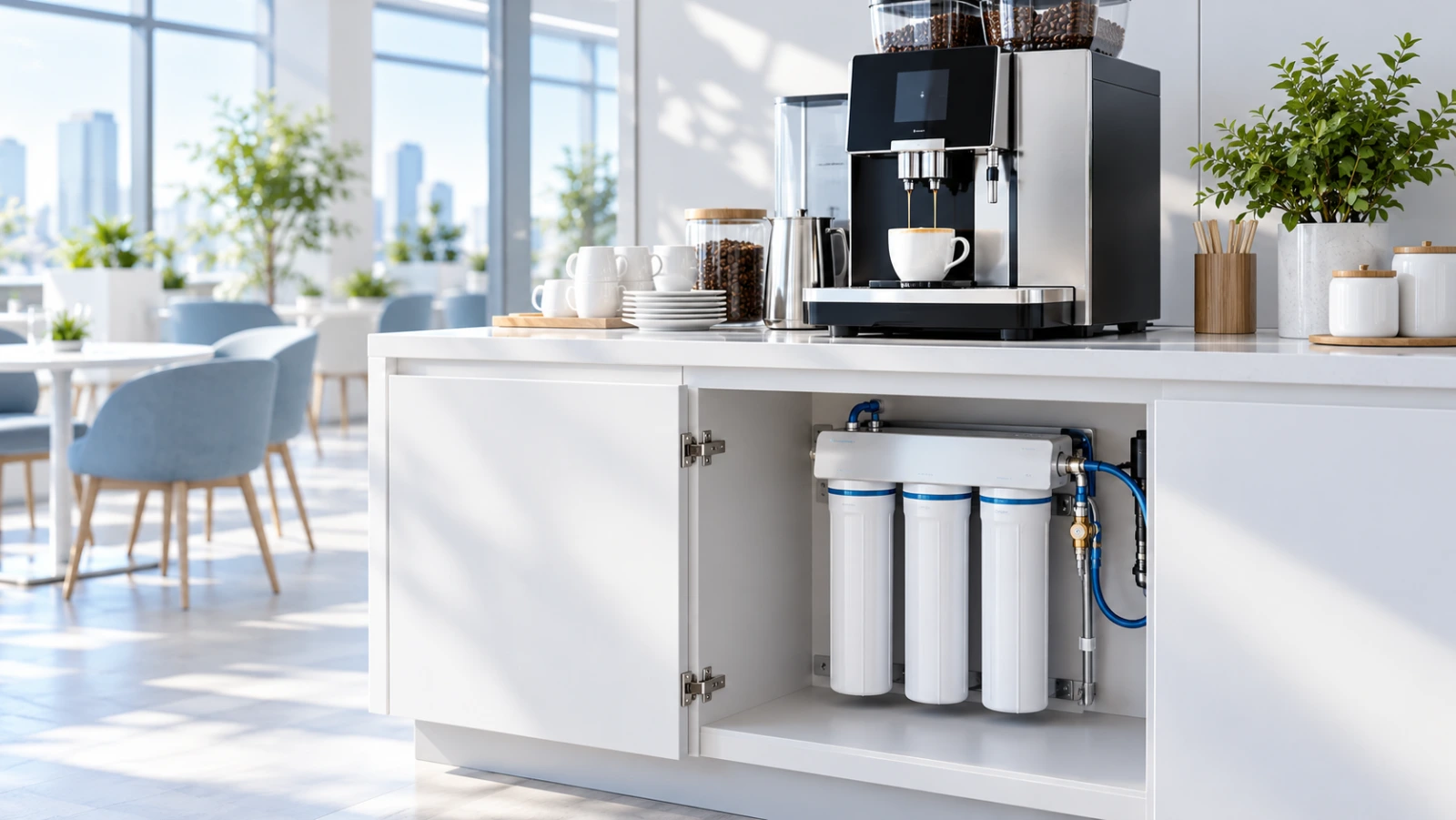
That growth is good news for equipment manufacturers, but it also multiplies a less visible requirement: every new machine is a new point-of-use water treatment problem. Super-automatic machines concentrate brewing, steaming and cleaning functions into a compact, sensor-heavy chassis. They are exactly the kind of equipment where poor inlet water turns into service calls, warranty claims and reputation risk.
Water Chemistry Decides Reliability and Total Cost of Ownership
Hard water is the primary threat. Dissolved calcium and magnesium bicarbonate precipitate as carbonate scale the moment water is heated, coating boilers, thermoblocks, flow meters and solenoid valves. Scale narrows flow paths, forces heaters to work harder, and eventually causes components to fail — often just outside the warranty window. In hard-water regions of Southern Europe and across the Middle East, a machine without scale management is effectively operating with a known, avoidable failure mode.
Chlorine and chloramine are the second front. Municipal disinfection residuals degrade rubber seals, gaskets and O-rings over time, and they directly compromise flavour by reacting with organic compounds in the brew. Sediment and turbidity add a mechanical threat, clogging fine orifices and flow restrictors. Finally, water chemistry shapes extraction itself: total dissolved solids and hardness influence how coffee solubles are pulled from the grounds, which is why specialty programs aim for a balanced mineral profile rather than simply “clean” water.
Filtration as an OEM and Private-Label Strategy
For equipment makers and distributors, filtration is no longer an after-sale accessory — it is increasingly part of the platform. Many OEMs now bundle dedicated filter heads and quick-change cartridges at the point of installation, then attach them to service contracts that generate recurring revenue and keep warranty exposure under control.
That shift opens a genuine private-label opportunity. Distributors and service partners can source cartridges under their own brand, cross-referenced to the filtration fittings already in the field. The procurement signals buyers should look for are well established: NSF/ANSI 42 for chlorine and aesthetic reduction, NSF/ANSI 53 for health-related contaminant claims, and their European equivalents for drinking-water component compliance. For a vendor-neutral buyer, certification is the clearest indicator that a cartridge will perform to spec rather than simply fit the housing.
What Buyers and Distributors Should Evaluate
A sound specification starts with a water analysis, not a catalogue. Hardness, chlorine, TDS and turbidity vary dramatically across a single city, let alone between Frankfurt, Riyadh and Dubai. From there, the cartridge spec follows: sediment pre-filtration, activated carbon for chlorine and taste, and a scale inhibitor suited to the measured hardness. Micron ratings, rated capacity and flow rate must match the machine’s pump and duty cycle, not just its fittings. In extreme-hardness Gulf conditions, blended reverse osmosis — which cuts TDS while retaining controlled minerals — is often the only reliable answer.
Replacement scheduling matters as much as the initial fit. A cartridge that is never changed protects nothing, so serviceable quick-change designs and clear cycle guidance are worth more than marginal upfront savings. For OEMs and channel partners, the lesson is simple: the fastest-growing category in coffee equipment is also the one where water quality most directly determines uptime, warranty cost and customer satisfaction.
Plan the filter and replacement cartridge together
For a bean-to-cup installation, send the machine model, inlet-water report, peak flow and daily demand. Confirm cartridge fit and the equipment supplier's water requirements before choosing a filter.
Commercial coffee filtration · Coffee filter cartridges · OEM and private-label supply
Use the exact machine and cartridge reference
For a bean-to-cup or super-automatic installation, identify the machine model, existing cartridge, connector and equipment inlet requirements. Confirm sample fit before assigning a replacement cartridge across an installed fleet.
Have a water filtration project?
Tell us your market, application and water conditions. Our team will help you define the right solution for coffee, residential or OEM private-label programs.